
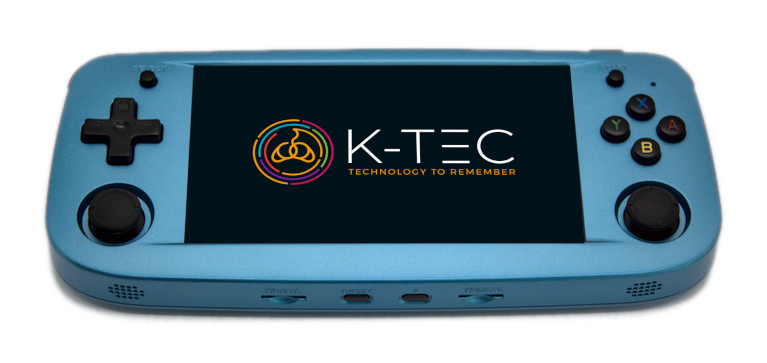

The Rockchip RK3566 is the chip that made serious PSP emulation practical on a budget handheld. Across the Anbernic RG353M, RG353V and RG DS, it has the headroom to run PPSSPP — the open-source PSP emulator — at full speed on a great many titles.
This work began on the widescreen OLED Anbernic RG503, whose panel matched the PSP’s native widescreen format and could render several titles at double the native resolution. The RK3566 devices that followed it inherit the same capability.
Getting there, though, is not a matter of installing PPSSPP and pressing start. PSP games are inconsistent under the bonnet: one wants a different rendering backend, another an adjusted CPU clock, a third a specific resolution scaling or a shader swap to hold a steady frame rate on a small screen. Left at the defaults, even capable hardware stutters on the titles that need the most help.
That per-title tuning is exactly the kind of invisible work I carry out on every device before it leaves K-TEC. To make the benefit wider than the handhelds I sell, I keep the optimized PPSSPP settings I apply in a public repository:
gitlab.com/k-tec/rk3566-ppsspp-settings
If you bought an RG353M, RG353V or RG DS from K-TEC, these settings are already applied as part of the PSP configuration on your device — there is nothing for you to install or tune. The repository exists for everyone configuring their own RK3566 handheld, and to keep the work transparent and open to improvement.
The starting set covers a spread of demanding PSP titles and is measured against my default profile. Most other games run well on those defaults; where one does not, it is usually a single setting away from smooth.
If a setting does not work for you, please raise an issue so I can refine it. And if you have tuned a game that runs better with a different configuration, contributions are welcome.

Leave a Reply