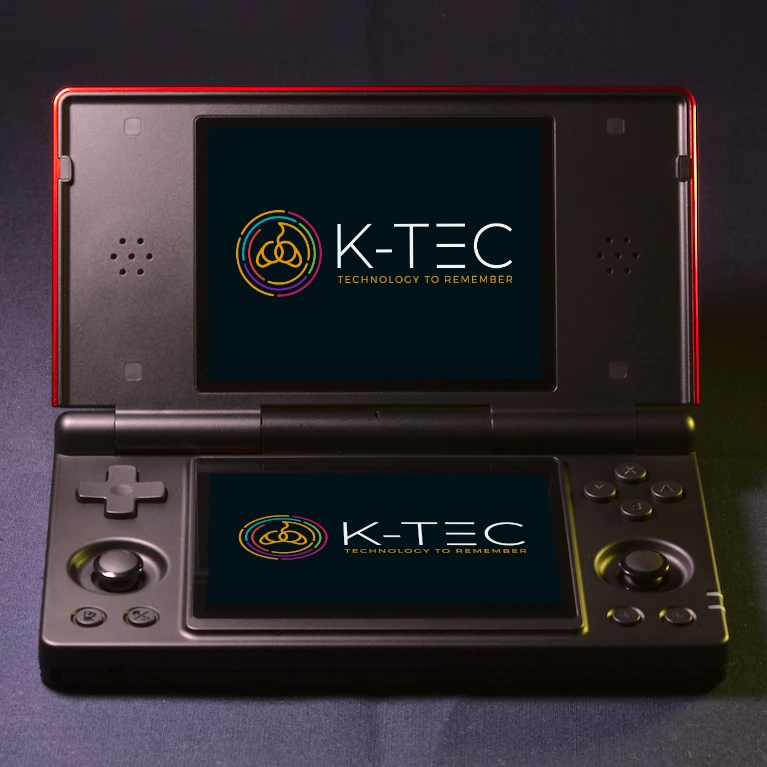

There’s a moment that happens when you first open a clamshell dual-screen device. The smooth reveal of two screens. If you played Nintendo DS as a kid — or watched someone else play one — that form factor hits you somewhere specific. It’s not nostalgia for a screen. It’s nostalgia for the way you held it, the way you touched the bottom screen with the stylus, the way the action lived on top and the map lived below.
I knew the moment I picked up the Anbernic RG DS that this was something different. Not just another retro handheld. A device with a specific purpose.
The question was whether I could make it live up to that purpose.
The hardware got there first
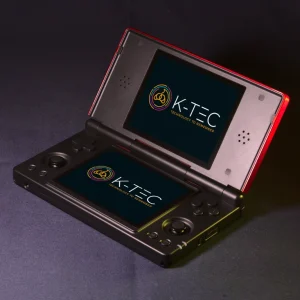
The RG DS is a clamshell with two 4.0-inch IPS displays. Dual screens. Touch control. Hall Effect analogue sticks that won’t develop drift. A 4000 mAh battery for long play sessions. It closes with a satisfying snap — surprising quality at this price.
You can see what Anbernic were going for. The hardware was built to play Nintendo DS games. And when you hold it, you can feel it. The screens are the right size. The touch is responsive. The whole thing feels like a DS that learned some new tricks.
But hardware is only half the story.
The software didn’t keep up
When the RG DS launched in December 2025, the reviews were clear: the hardware was promising, but the stock software let it down. NDS games didn’t display properly across both screens. The experience fell short of what this dual-screen design deserved.
Retro Game Corps said it plainly: “Custom Firmware Saved the Anbernic RG DS.” Joey’s Retro Handhelds went further: “GammaOS Next on the Anbernic RG DS is a must have.”
They were right. The stock firmware turned a brilliant piece of hardware into something that didn’t deliver on its potential. And that’s exactly the kind of device that belongs at K-TEC — hardware that deserves better than it got from the factory.
GammaOS Next changed everything
GammaOS Next, built by TheGammaSqueeze on Android 14 for retro gaming handhelds, transformed what the RG DS could do.
NDS games now display way they were designed to. Touch input is responsive. The screens are correct. The whole dual-screen concept goes from “nice idea, poorly executed” to “this is what the hardware was made for.”
That transformation is the foundation. What I do on top of it is what makes it a K-TEC device.
39 platforms, and the invisible work
I configure and verify 39 gaming systems on every RG DS. PS1, N64, SNES, Mega Drive, Game Boy Advance, Dreamcast, PSP, Commodore 64, ZX Spectrum, Amiga — each one tested and working.
But the number isn’t the interesting part. The interesting part is the per-game work that no other reseller does.
ZX Spectrum games, for instance, were designed for a keyboard. On a stock system, most Spectrum games simply don’t respond to a gamepad. So I went through hundreds of them individually, mapping keyboard controls to the gamepad for each game. Pick any Spectrum title on a K-TEC RG DS and the controls just work. No struggling with a virtual keyboard. No troubleshooting.
I added 35 per-game screen overlays for the Vectrex that recreate the coloured plastic sheets shipped with the original cartridges. I configured the Dreamcast library for PAL performance — PAL’s lower frame rate is less demanding on this processor, so games run more smoothly. I created individual controller configurations for PS1 games that need analogue input — 20 per-game remaps so the analogue sticks work the way the games expect.
This is the work that takes a device from “it works” to “it feels right.” And you never see it — you just notice that things work the way they should.
What the RG DS is really about
Here’s the thing about the RG DS: it’s not trying to be everything. It was built for Nintendo DS, and when it’s configured properly, that’s exactly what it does brilliantly.
But because it runs Android with a capable RK3568 processor, it also handles the classics — NES, SNES, Mega Drive, Game Boy, GBA, PS1 — with room for N64, Dreamcast, and PSP. The dual screens even let you multitask: browse the web on the bottom screen while your game runs on the top screen.
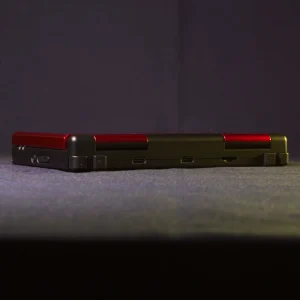
The form factor is part of the experience, too. Fold it shut and both screens are protected. Slide it into your pocket and there’s nothing sticking out — no thumbsticks poking through, no buttons to catch. It’s a device that wants to go somewhere with you.
What it’s not
I wouldn’t be honest if I didn’t tell you where the ceiling is.
The RG DS is not capable of 3DS, PS2, GameCube, Wii, or anything above. 3DS is the natural question — yes, it’s a dual-screen device, but 3DS emulation requires more power than this processor can provide. For proper dual-screen 3DS, you’d be looking at premium devices like the AYN Thor — a different category entirely, starting around £442.95.
There’s no video out. You can’t connect it to a TV.
And I should be clear: this is not the device I’d recommend if NDS isn’t part of what drew you here. If you just want a great all-rounder for PS1 and below, the BATLEXP G350 does that for less. If you want more power and Android features, the Anbernic RG405M or Retroid Pocket 3+ are the step up.
I’d rather you bought the right device than the wrong one, even if it’s not this one.
Why buy it from K-TEC?
You can buy the RG DS direct from China or from Amazon resellers. You’ll pay less. You’ll also wait three weeks for delivery, possibly pay import VAT on arrival, and receive the stock firmware — the one reviewers found wanting. No custom firmware. No per-platform tuning. No per-game configurations. No guarantee on the storage.
Every RG DS from K-TEC ships with:
- GammaOS Next — installed, configured, and refined. The firmware that transformed this device.
- Brand-name Kioxia (Toshiba) MicroSD card — reliable storage for your games, not a no-name factory card.
- Lifetime SD Card Guarantee — if your SD card fails, I’ll replace it. No one else offers this.
- Free UK delivery — Royal Mail Tracked 48, 2–3 working days.
- UK-based support — if something goes wrong, you talk to me. The person who configured your device.
Open the box, turn it on, play. That’s the whole point.
Not sure?
If you’re trying to choose between devices — or if you’re not certain the RG DS is right for you — get in touch. I’m happy to talk you through the options. No pressure, no upsell. Just honest advice from someone who spends their days doing this.
If the RG DS sounds like what you’re after, you can check it out here.
Want to see how K-TEC’s price and service compare to other RG DS sellers? Read the Where to Buy the Anbernic RG DS in the UK guide.
Leave a Reply